Sunday, May 29, 2016

Do I Need to Register For GST in Malaysia?

Goods and Services Tax (GST) is a multi-stage tax on domestic consumption. GST is charged on all taxable supplies of goods and services in Malaysia except those specifically exempted. GST is also chargeable on the importation of goods and services into Malaysia.

Who shall register under GST?

Any person who makes a taxable supply for business purposes and the GST exclusive value of the taxable turnover of that supply for a period of 12 months or less exceeds the threshold of RM500,000 is required to be registered for GST.
However, business with taxable turnover of RM500,000 and below, even though not required to be registered, may choose to apply for voluntary registration.
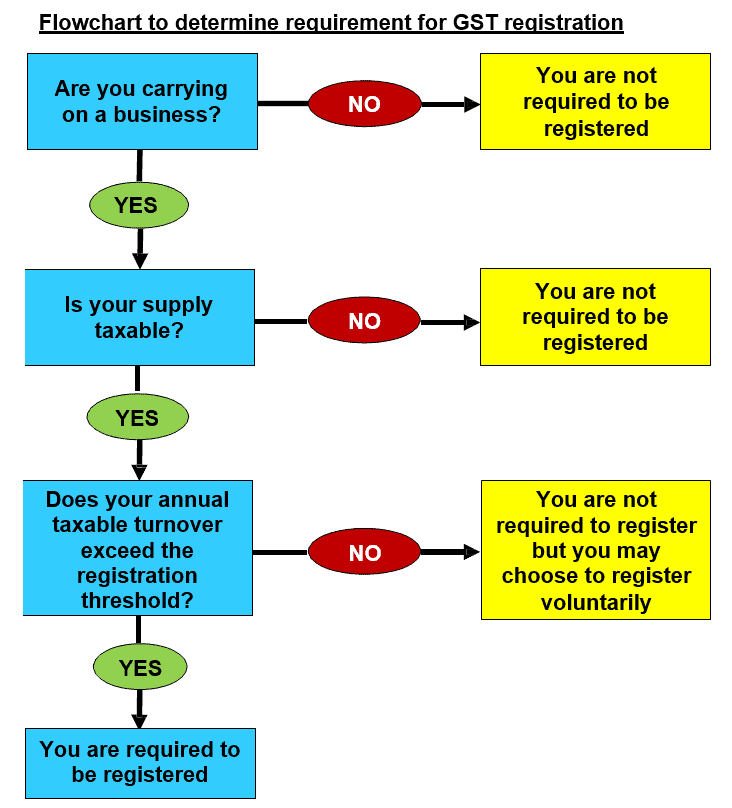
Requirement for GST Registration

What is a taxable supply?

A taxable supply is a supply with consideration and it includes standard-rated and zero-rated supply. Supply without consideration can also be deemed to be a supply. However, certain taxable supplies are not regarded as supplies for GST purposes. Please refer to the GST Guide on Supply for further clarification on the various types of supply.
GST Registration Taxable Supply

How to Compute the Total Taxable Turnover?

Taxable turnover means the total value of taxable supplies for a period of twelve months excluding the amount of GST.
The determination of taxable turnover for GST registration purposes has to include all supplies of goods and services which are taxable, i.e. standard rated supply, zero rated supply, deemed supply as well as disregarded supply. However, the following taxable supplies will not be included:
(a) disposal of capital assets;
(b) imported services;
(c) supplies made in relation to Warehousing Scheme;
(d) supplies of goods made within or between designated areas; and
(e) supplies made by a foreign principal or a recipient under the Approved Toll Manufacturer Scheme.
The method to use for computing taxable turnover depends on the category of person, e.g. sole-proprietorship, partnership or company.
Category of PersonTaxable Turnover
A companythe value of all taxable supplies made by that company
A company with divisions or branchesthe value of all taxable supplies from all divisions and branches (We allow branch registration only IF the company itself is already registered, i.e either mandatory registration or voluntary registration. Sec 30 requires the company to fulfill 6 conditions before approval for branch registration is allowed)
A sole proprietor/ an individualthe value of all taxable supplies of his business
A partnershipthe value of all taxable supplies by the partnership
A single taxable personthe value of all taxable supplies by the business entities registered as a single taxable person
A joint venturethe value of all taxable supplies made by the joint venture
A foreign principalthe value of all taxable supplies made in Malaysia by the foreign principal
The taxable turnover for a period of twelve months can be determined based on either the historical or the future method.
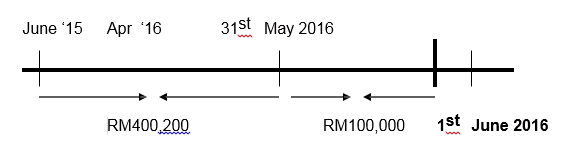
The historical method is based on the value of the taxable supplies in any month plus the value of the taxable supplies for the eleven months immediately before that month. The determination of historical method is explained as in Diagram below.

Historical Method
GST Registration Historical Method
At the end of May 2016, the value of taxable supplies for the month of May is RM100,000 and the value of taxable supplies for the eleven months backward (i.e. from June 2015 to April 2016) is RM400,200. The total value (annual taxable turnover) of all taxable supplies is RM500,200. The taxable turnover has exceeded the threshold starting from 1 June 2016 and the business is liable to be registered for GST within twenty eight days from this date, i.e. 1 June 2016. The effective date for GST registration is 1 July 2016 (first day of the following month after the end of the twenty-eight day liability) since the annual taxable turnover has exceeded the threshold limit on 31 May 2016.
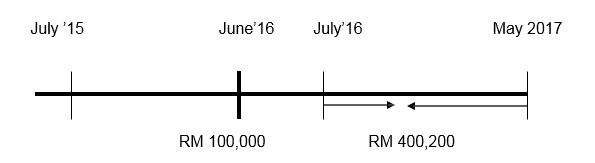
For the future method, the taxable turnover is based on the value of taxable supplies in any month plus the expected value of taxable supplies for the eleven months immediately after that month. A business will have reasonable grounds to expect its taxable turnover to exceed the threshold if it has signed a written contract to supply taxable goods or services. The determination of future method is explained as in Diagram below.

Future Method
GST Registration - Future Method
If at the end of June 2016, the value of taxable supplies for the month of June is RM100,000 and his supplies for the preceding eleven months (i.e. from July 2015 to May 2016) does not reach the threshold, he must look at the expected turnover from July 2016 to May 2017. Since his taxable supplies for the month of June 2016 is RM100,000, if he reasonably expects his turnover for the next eleven months (i.e. from July 2016 to May 2017) to be more than RM400,000, then he is liable to be registered for GST within 28 days from the end of the month of June 2016, i.e. from 1 July 2016 to 28 July 2016. The effective date for GST registration is 1 August 2016 (first day of the following month after the end of the twenty-eight day liability) since the annual taxable turnover has exceeded the threshold limit on 30 June 2016.

When You Liable to Register For GST?

You must apply for GST registration within 28 days from the date the annual taxable turnover exceed RM500,000 (determined based on either the historical or the future method).
The effective date of registration is on the first day of the following month after the end of the twenty eight days liability.
You have to submit your application for GST registration by the due date to avoid being penalised for late notification of your liability for GST registration

What are the Consequences for Late GST Registration?

A person who is late in applying for registration will be liable to pay a late registration penalty from the date he should have been registered to the date immediately before the date he is so registered, and this period is referred to as the late registration period. Late registration penalty will be imposed according to the following table:
Late registration period (Days)Amount of penalty (RM)
1 – 301,500
31 – 603,000
61 – 904,500
91 – 1206,000
121 – 1507,500
151 – 1809,000
181 - 21010,500
211 - 24012,000
241 – 27013,500
271 – 30015,000
301 - 33016,500
331 – 36018,000
Exceeding 36020,000
A late registrant is required to submit tax return according to the taxable period assigned to him, i.e. monthly or quarterly. The first taxable period will commence from the date he should have been registered.

Friday, May 27, 2016

TAXATION MATTERS ON LLP

Submission of Estimate of Tax Payable and Tax Payment

LLP is required to provide estimate of tax payable and payment by instalments as provided in section 107C ITA. This mean LLP need to submit Estimate of Tax Payable vide Form CP204 for a Year of Assessment not later than 30 days before the beginning of the basis period. However, when a LLP commences operations (i.e. during the first basis period), the estimate of tax payable must be submitted to the Inland Revenue Board (IRB) within 3 months from the date of commencement of its business and thereafter no later than 30 days before the beginning of the basis period.
Tax is generally payable by 12 equal monthly instalments, each monthly tax instalment is due and payable to the IRB by the 15th of the following month.
An LLP that is converted from a company or a partnership is not exempted from estimate of tax payable and payment by instalments under subsection 107C (4A) ITA as the business of the LLP is deemed to be a continuous business of the company or the partnership.

Filling of Tax Returns (Form PT)

All LLP must file the tax returns (Form PT) within 7 months from the date of closing of its basis period (i.e. accounting period).

Restrictions on Partner’s Salary Deduction

Remunerations or similar payments to partners of LLP are not allowable for deduction if not specified or provided for in the LLP agreement. Remuneration refers to basic salary and fixed allowances but does not include employer’s contributions to the Employees Provident Fund (EPF), Social Security Organisation (SOCSO) or insurance.
Remunerations to be paid to the partners should be documented in the LLP agreement. Thus, if there is a change of partners in the LLP, where new partners will be paid remuneration, the LLP must prepare a supplementary agreement or any document to record the change.

Incorporation Expenses

LLP which has capital contribution not exceeding RM2.5 million shall be allowed a deduction in respect of incorporation expenditure for the basis period for a year of assessment, as provided in the Income Tax (Deduction for Incorporation Expenses) Rules 2003 [P.U.(A) 475/2003] and the income Tax (Deduction for Incorporation Expenses) (Amendment) Rules 2005 [P.U.(A) 472/2005].

Distribution of profits to partners

LLP can distribute profits to its partners. The profits paid, credited or distributed to partners in the LLP are exempt from tax. There is no withholding tax on profits paid, credited or distributed to the partners.

Tax Treatment of Partners of A LLP

Partners are not liable to tax on their share of income from LLP (whether distributed or not). Nevertheless, they will be taxed on remunerations, perquisites and benefits-in-kind received from the LLP. The payment (non-distribution of income) is subject to income tax and is charged on the person concerned.

Responsibilities of Compliance Officer for Income Tax Purposes

Responsibilities of the compliance officer or partner for income tax purposes amongst others are that he is required to:
  • keep complete accounting records of the business of the LLP.
  • complete and submit the income tax return form (ITRF) in accordance with section 77A ITA and amendment of ITRF if any, in accordance with section 77B ITA within the prescribed period.
  • provide estimates of tax payable and make instalment payments in accordance with section 107C ITA.
  • inform the Director General of Inland Revenue (DGIR) on the changes of accounting period by submitting Form CP204B within the prescribed period (PR No. 7/2011 titled ‘Notification of Change of Accounting Period of a Company/Trust Body/Co-operative Society’).
  • ensure payment of tax by the LLP.
  • undertake any other responsibilities under the ITA.

TAXATION ON LLP

Tax Treatment of LLP

LLP have a similar tax treatment like Company* where chargeable Income from LLP will be taxed at the LLP level at tax rate of 25% generally. However, LLP with capital contribution of RM2.5 million or less will enjoy a preferential tax rate of 20% on the first RM 500,000 of its chargeable income. Profits paid, credited or distributed to partners in the LLP are exempt from tax. There is no withholding tax on profits paid, credited or distributed to the partners.
* Specific incentives provided to a company do not apply to an LLP.

BUSINESS SERVICES

we provide as follow:

Accounting & bookeeping services
Audit
Taxation
Financial Management
Management Account
EPF registration
SOCSO registration
Internal Audit Activity
GST registration
Full set of accounts
Train your accounting staff
Cashflow management
Accounting software

Please call Iskandar 019-3427004 for further details.